In the field of aircraft seat component manufacturing, operations must be centered around the stringent standards of the aviation industry, with a deep integration of material characteristics and precision manufacturing technologies. The entire process adheres to three core principles: "precision control, performance assurance, and compliance traceability."
To meet the rigorous standards of the aviation industry and address the manufacturing requirements for aircraft seat components, we have developed a CNC precision machining solution centered on "precision control, performance assurance, and compliance traceability," using 2024-T351 aluminum alloy as the processing material.
This comprehensive solution covers all critical stages including material pre-treatment, precision machining, and quality inspection, ensuring that components meet aviation-grade safety and performance requirements.
We employ 5-axis CNC machining centers (with positioning accuracy ≤0.005mm and repeat positioning accuracy ≤0.005mm) to accommodate the multi-angle and multi-curved surface machining needs of complex components.
These machines are particularly suitable for the integrated machining of seat slide grooves and irregular skeleton structures.
For full-dimensional inspection, coordinate measuring machines (with measurement accuracy ≤0.003mm) are used to conduct comprehensive inspections of components, covering dimensional tolerances, geometric tolerances (coaxiality ≤0.02mm), and surface roughness (Ra ≤0.8μm for sliding surfaces and Ra ≤1.6μm for load-bearing surfaces).
Inspection data is uploaded to the traceability system in real-time, forming retrievable records.
The entire process complies with aviation standards, reducing rework rates.
The 5-axis machining enables integrated forming of complex components, improving processing efficiency by over 30% compared to traditional processes and meeting the mass production requirements of aviation components.

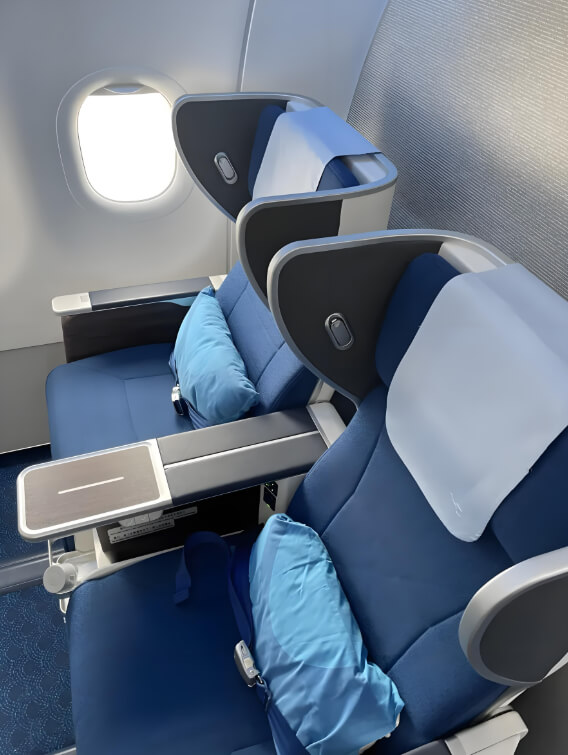 Aircraft seat components
 Jason
Jason +86 13902935856